Character Analysis of Rue - The Why Behind Rue
Dive into the deeper meaning of the main character in Wings of Ebony written by J Elle., Rue.
Jalia Blocker
1/8/20254 min read
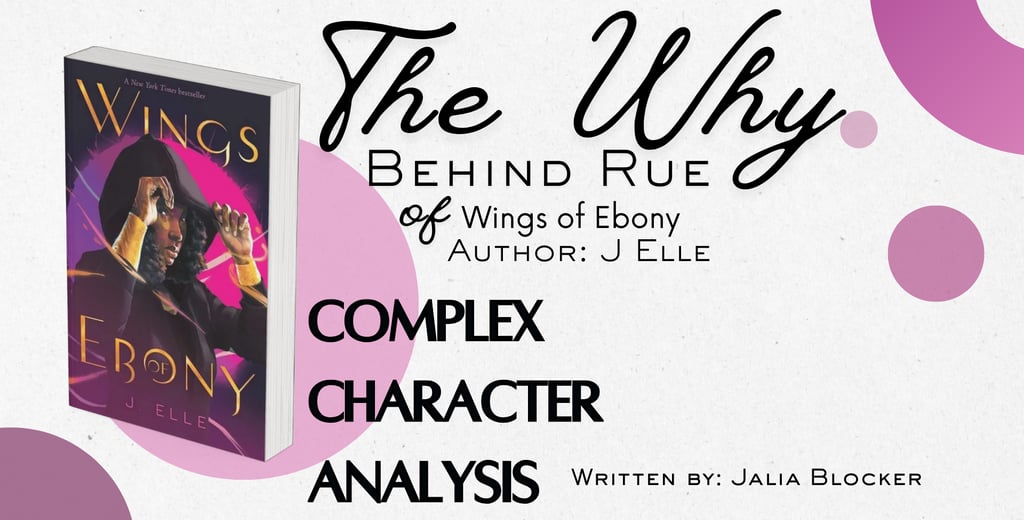
The Why Behind Rue
The author J. Elle wrote the book Wings of Ebony and published her work on January 26, 2024, having sold 14 million copies of this series. Wings of Ebony is an eye opening book that has a powerful narrative, using social commentary to highlight injustices in today’s society. The author uses cultural diction and first person narrative to fully capture the essence of socioeconomic disparity amongst the black community. Having published a series of books that had the same inspiration in writing them bringing social awareness to racism, strengthens J. Elle's ability to understand different perspectives. Considering she grew up in Houston, Texas and living a nomadic lifestyle as a teenager, similarly to the main character Rue, she is able to write with first hand experience and evoked emotions throughout the book. Though J. Elle isn’t an award winning author, she is one of New York's best selling authors demonstrating an unique style in her fantasy novels like Wings of Ebony and Ashes of Gold. She wanted to create a book she could relate to, causing her to publish a book a whole community could relate to also. A review published by following-good-books on March 29th, 2022, mentions the importance of family and community within the book that represents and explains Rue's dynamic. They highlight the combination of realistic themes and how it introduces them in a metaphorical way through the perspective of the main character, Rue, in a fantasy novel. The purpose of this review on Wings of Ebony written by J. Elle is to provide an insight into the meaning and symbolism of the main character.
Providing a complex character analysis on the first person point of view speaker Rue, will help readers envision the characters community and the why behind Rue. Having this fantasy novel being written in first person, it allows us to connect deeper and understand the main character. Throughout the novel, Rues community and values are highlighted with J. Elle’s strong diction and descriptive imagery such as “My niggas. The whole damn block is Family.” and “Two doors down, dudes in glistening chains, hoodies, and baggy jeans chop it up, slapping hands and giving one arm hugs”. The environment she was raised in, she took pride in it, and had a sense of family and unity in East Row. Not to mention her mother always told Rue she raised a diamond, strengthening the mindset of you can never be broken. Having the plot of the book begin with Rue wanting to see her sister, whilst breaking the rules in Ghizon, the world she was taken to forcefully, gives an early insight on Rue's dynamic. This demonstrates the resilience and strong mindedness within Rue, which plays a key role in her actions and beliefs.
The main character, Rue, is portrayed by J. Elle in a way that is relatable to teenagers who have experienced a similar complex family dynamic and social internal conflict. To start with, Rue calls her father by his first name, Aasim, and refers to him as “The one mom laid up with to make me …”. Considering she watched her mother struggle as a single parent, having to work double shifts, she also refers to him as “… my sperm donor…” since he didn’t provide any monetary support or fatherly guidance in her life. Rue’s dislike of Aasim strengthened when he forced her to go to Ghizon resulting with magic she knew nothing about. Being she was there for eleven months, even enrolling in school, Rue was unable to become accustomed to the new social norms. She stated “These ain’t my people.” evoking even more her desire to return home to her sister, Tasha. There was also resentment towards her father after being kept there for eleven months and built up guilt for disappearing on her sister because of this.
Rue’s father was excited for her on Designation Day, an important gathering for the Ghizonens where the youth are given their magical career path. Everyone there looked different, having a “grayish skin tone”, and they were all thrilled except for Rue. She didn’t understand why they were happy to have their future chosen for them, instead of being allowed to choose their own path. Rue preferred to create her own future with what she considered to be her only family, her sister Tasha. That day, she met a girl around her age that she bonded with quite quickly, Bri, a Ghizonen. They connected through sharing similar social characteristics like prejudice and barriers within an indifferent society. It allows the reader to infer that Rue can bond with different people when she gains trust in them and they share similar life issues. Bri confides her passion for inventing gadgets, showing Rue her “watch” that can teleport things anywhere, without being detected by magic. Rue decides to tell Bri about her sister, a human, that she is desperate to see and they devise a plan to teleport Rue home to see Tasha on the anniversary of her mother’s death. Although the transportation spell is illegal, they go through with the plan. Rue states “Law is law” then counters it by saying “I bucked up against the law” showing her defiance against the Ghizonen policy.
J. Elle did a great job with her descriptive language through imagery and diction regarding Rue. It gives the readers, definitely me, a strong vivid visual of the character and her neighborhood, East Row, creating insight that allows readers to better understand the actions and environment of Rue and other characters. Even though the novel is written in Rues first person perspective, J. Elle leaves room to learn more about Rue through the characters introduced like Tasha and Ms. Leola. By breaking the Ghizonen law, Rue showed her strong love and support for her sister, Tasha, and wanting to do the right thing, sticking by your family. Unfortunately I do believe J. Elle should’ve provided more background information on Rue's life growing up. She only gives important details that fall within the storyline of her dead mother and absent father which takes away the spotlight from little Rue, and the true beginning of her relationship with society. Throughout the book, the author was capable of evoking many feelings using pathos that made me more interested in the book, looking forward to a mood shift regarding the obstacles Rue faces. I would recommend this book to specifically the black community because they’re able to genuinely connect with Rue's social issues and community culture. Considering J. Elle wanted this book to be relatable to many, she achieved this goal by using social commentary by highlighting the descriptive imagery amongst the characters.